How Much Does It Cost to Build a House in Ontario in 2026?
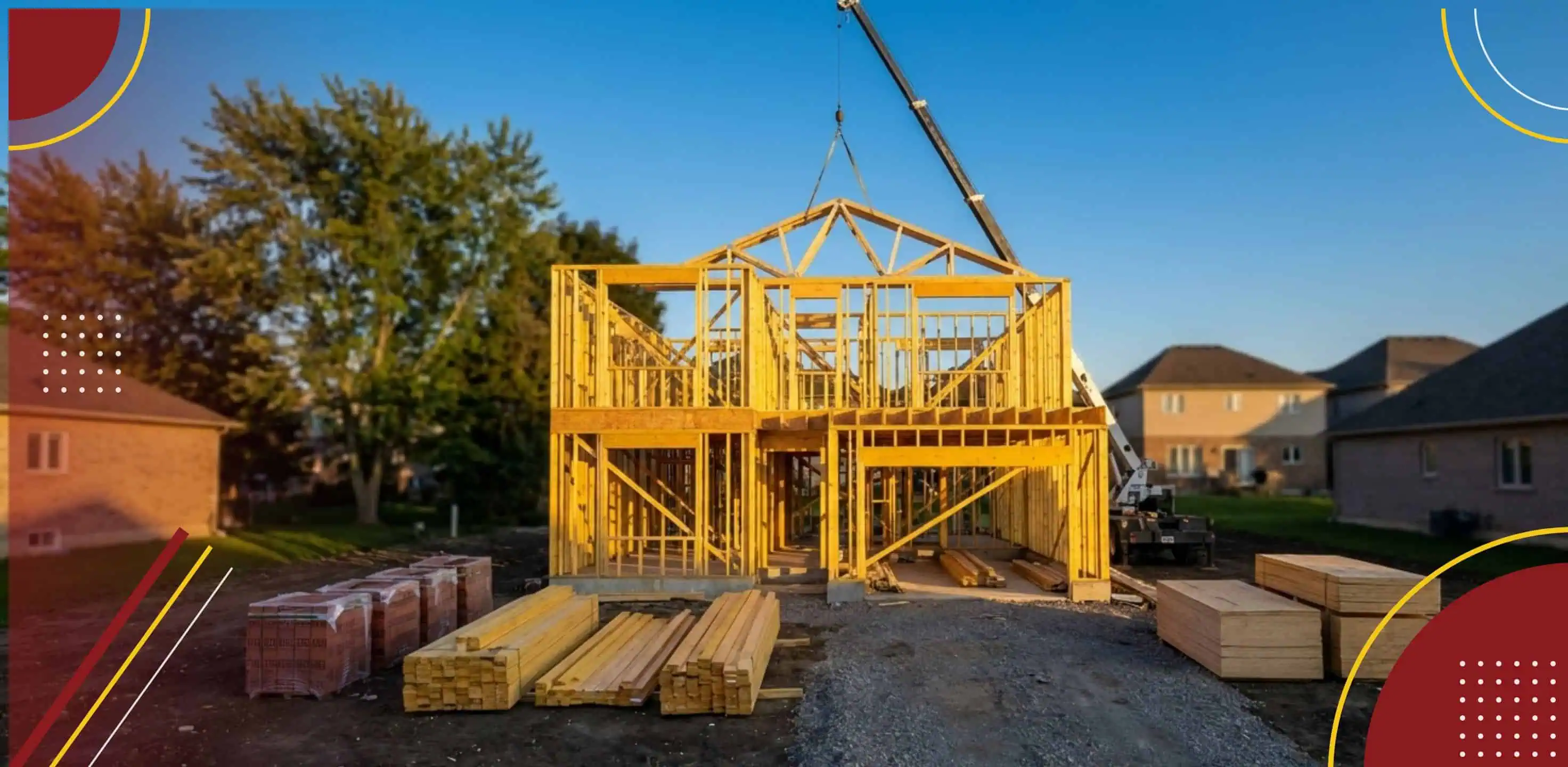
The cost to build a house in Ontario in 2026 is about $375 to $500 per square foot for a professionally built detached home, construction only, based on the planning range in RE/MAX Canada's August 2026 cost guide. That puts a 2,000 sq ft house at roughly $750,000 to $1 million, not including land. Development charges, permits, servicing, design fees and 13% HST sit on top, and in some cities they add six figures.
Most people price the build first and the borrowing second, but the two are linked. Lenders that offer home construction loans release the money in stages as the work reaches set milestones, so your budget has to hold up line by line before the first draw. This guide breaks down each cost with current numbers, shows where the rebates are, and explains what changes if you act as your own builder.
Quick cost summary
| Cost item | What to budget | Source and date |
|---|---|---|
| Construction (detached, professionally built) | $375 to $500 per sq ft | RE/MAX Canada, August 2026 |
| Construction (all build types and finishes) | $300 to $800 per sq ft | RE/MAX Canada, August 2026 |
| Development charges, Toronto single or semi | $137,846 per unit (rate effective June 26, 2025) | City of Toronto |
| Building permit, Toronto house | $18.56 per m² of floor area (2026) | City of Toronto |
| Building permit, Hamilton house | $18.32 per m² of floor area | City of Hamilton |
| HST on new construction | 13% | Canada Revenue Agency |
| Land | Not included in any of the figures above |
Sources: blog.remax.ca, toronto.ca, hamilton.ca, canada.ca, checked November 2026.
Cost to build a house in Ontario per square foot
Per-square-foot figures vary a lot between guides, and the reason is what each one counts. The RE/MAX guide gives a wide $300 to $800 range across all build types, then narrows it to $375 to $500 for professionally built detached homes. HomeStars' Ontario price guide uses $300 to $600, with luxury builds going past $700.
Three things push your number up or down:
- Finish level: Cabinets, flooring, windows and fixtures are where custom homes pull away from basic builds.
- Shape and storeys: A two-storey house puts more living space on the same foundation and roof, so it usually costs less per square foot than a bungalow of the same size.
- Location and site: Labour, permit fees and charges are higher in the GTA, and a sloped or rocky lot raises foundation costs anywhere.
How much does a 1,500, 2,000 or 2,500 sq ft house cost?
Using the $375 to $500 range for a professionally built detached home, construction only:
| House size | Low estimate | High estimate |
|---|---|---|
| 1,500 sq ft | $562,500 | $750,000 |
| 2,000 sq ft | $750,000 | $1,000,000 |
| 2,500 sq ft | $937,500 | $1,250,000 |
These totals leave out land, development charges, permits, servicing, design and HST. The next section covers each of those.
What the per-square-foot price leaves out
Land
Every figure above assumes you already own a lot. Land is often the single biggest line after construction, and its price depends on the town, lot size and whether services reach the property. If you still need a lot, a loan for buying land can cover raw or undeveloped land, and our guide to getting a mortgage for land explains how lenders look at vacant lots differently from houses.
Development charges
Municipalities charge development charges (DCs) to pay for roads, water, sewers and other services that new homes use. In Toronto, the charge for a single or semi-detached home that is not a rental is $137,846 per unit under the rates in effect since June 26, 2025, so confirm the current rate with the City before you budget.
Two recent changes matter here:
- Payment timing: Under Ontario's Bill 17, DCs on non-rental homes are now due at occupancy rather than when the building permit is issued. This took effect on November 3, 2025.
- Possible reductions: The Canada-Ontario Development Charge Reduction Program funds cities that cut residential DCs by 30 to 50% or more. Toronto has adopted reductions of 40 to 60% by unit type, subject to a funding agreement with the province, and Hamilton has said it plans to remove residential DCs for three years once its funding agreement is signed. Until a reduction is in force, the full charge still applies.
Ask your municipality for the exact charge on your lot before you sign anything, since rural, urban and service-area rates can differ.
Building permits and inspections
You need a building permit for any new structure over 10 m² in Ontario, and it is issued only once the plans meet zoning. For a house, the municipality must decide on a complete application within 10 days. You then book inspections at each stage the Building Code sets.
Permit fees are modest next to DCs. Toronto charges $18.56 per m² of floor area for houses in 2026, so a 2,000 sq ft (about 186 m²) house would pay roughly $3,450. Hamilton charges $18.32 per m².
Site servicing, septic and wells
A city lot usually connects to municipal water and sewer. A rural lot may need a septic system and a well, which both have their own rules:
- Septic: Needs a separate permit and a site evaluation under Part 8 of the Building Code. Toronto charges $773.26 for this permit and Hamilton $1,010.
- Well: Must be built by a licensed well contractor, who has to give you a copy of the well record within 14 days of finishing the well's structural stage.
Clearing, grading, driveways and hydro hookups also land in this bucket, and they vary most from one lot to the next.
Design, engineering and surveys
Architectural drawings, structural engineering, a lot survey and, on some sites, soil testing all come before a permit is issued. Get quotes from local firms and list each one separately.
HST
New construction in Ontario carries 13% HST, made up of the 5% federal part and the 8% provincial part. If a builder charges $750,000 for construction, the HST alone is $97,500. If you build yourself, you pay HST on the materials and trades you buy. Rebates can return part or all of it, as covered below.
Building costs in the GTA vs the rest of Ontario
Construction price trends are not the same across the province. Statistics Canada's building construction price index for the third quarter of 2026 shows residential costs:
| Area | Change, Q3 2025 to Q3 2026 |
|---|---|
| Toronto | +0.3% |
| Ottawa (Ontario part) | +4.6% |
| London | +5.0% |
| 15 cities combined | +2.7% |
Source: Statistics Canada, released October 29, 2026.
Altus Group's April 2026 commentary on its Canadian Cost Guide also found that low-rise residential costs in Toronto eased over the past year while labour costs stayed largely flat.
The bigger gap is everything around the build. RE/MAX's guide links higher GTA costs to busy trades and heavier municipal requirements, and in older neighbourhoods land alone can outweigh the cost of the house. The same guide describes Southwestern and Eastern Ontario as a cheaper starting point for land, labour and materials. Rural lots carry their own catch: fewer local builders to choose from, and a site without municipal services needs its own septic system and well.
HST rebates when you build your own home
Owner-built homes have their own rebate rules, and the 2026 changes make them worth checking carefully.
- Regular new housing rebate: The federal part returns 36% of the 5% federal HST paid, up to $6,300, when the home's fair market value is $350,000 or less, and phases out at $450,000. The Ontario part returns 75% of the provincial HST, up to $24,000 (or $16,080 if you paid no HST on the land), with no value ceiling.
- Ontario Enhanced New Housing Rebate: For owner-built homes where construction begins between April 1, 2026 and March 31, 2027 and finishes before 2030, the enhanced and regular Ontario rebates together return up to $80,000 of the provincial HST on homes valued up to $1.5 million, phasing out by $1.85 million. Ontario's separate New Home Affordability Payment of up to $50,000 can cover the federal part, less any federal rebate you receive, and Ontario pays it separately from CRA.
- First-time home buyers' GST/HST rebate: First-time buyers who build can get up to $50,000 of the federal part when construction begins on or after March 20, 2025 and before 2031, with the full amount on homes up to $1 million and a phase-out to $1.5 million, if the home is finished before 2036.
For owner-built homes, each rebate is based on the HST you actually paid on land, materials and trades, and the home must be your primary residence (or a relation's, for the regular rebates). Owner-builders apply with form GST191, its construction worksheet and the Ontario schedule RC7191-ON, usually within two years of substantial completion. CRA accepts only original invoices in your name and expects you to keep them for six years, so file every receipt from day one.
Owner-builder or hire a builder?
If you hire a company to build on land you own, Ontario treats it as a contract home. The builder must hold a licence from the Home Construction Regulatory Authority (HCRA) and enrol the home with Tarion before construction starts, which gives you the statutory new home warranty.
If you act as the owner-builder, you pull the permits, hire and pay the trades, book inspections and check WSIB coverage for the trades you hire. You do not need an HCRA licence when you build for your own use, but the home has no Tarion warranty. Selling the home after you build it can bring the licence rules back into play.
How long does it take to build a house in Ontario?
Zoning approvals, drawings and permits come first, and a rural lot may need septic approval too. Once the permit is in hand, CMHC found that single-detached homes in Canada's six largest cities took an average of 10.7 months from foundation to occupancy in 2023.
RE/MAX's 2026 guide puts most detached builds at 9 to 18 months, plus time before construction starts. Winter weather, trade availability and lender inspections between draws can all stretch the schedule.
Is it cheaper to build or buy a house in Ontario?
It depends on the town and what you want. Building lets you choose the layout and finishes and may qualify you for new-home HST rebates, but you carry land, DCs, design costs and financing interest during construction. Buying a resale home is faster and its price is known on day one.
To compare fairly, add up land, construction, charges, permits, servicing, HST after rebates and interest during the build, then hold that total against similar homes for sale nearby. If you find a resale home that only needs upgrades, a purchase plus improvements mortgage can add the renovation cost to the mortgage.
How to pay for building a house
A regular mortgage is secured by a finished house, so self-builds normally use construction financing. The lender reviews the project, your credit, your down payment, the construction plan and the expected property value. You provide blueprints, contractor estimates, financial statements and a timeline.
Funds are then released in stages as construction milestones are reached. The construction loan is usually converted to or replaced by a regular mortgage once the home is finished. Our article on construction loan vs home loan explains how the two work together.
Working with an Ontario mortgage brokerage gives you one place to arrange land financing, construction financing and the mortgage that replaces it once the home is finished.
Budget checklist before you start
- Land: Purchase price, closing costs and land transfer tax.
- Approvals: Zoning, permits, septic permit and any conservation authority review.
- Charges: The exact DC for your lot and when it is due.
- Design: Drawings, engineering, survey and soil tests.
- Construction: A written quote that lists what is and is not included.
- Servicing: Water, sewer or septic, well, hydro, driveway and grading.
- Taxes: HST, plus the rebates you expect and when they will be paid.
- Financing: Interest during construction, appraisal and draw inspection fees.
- Contingency: A reserve for price changes and surprises found in the ground.
A common mistake is comparing builder quotes without checking exclusions. One quote may include the driveway, grading and appliances while another leaves them out.
Frequently asked questions
Does the cost per square foot include the basement?
Usually not when the basement is unfinished. Many builders quote finished living space only, and Toronto leaves unfinished basements out of the floor area used for permit fees. Confirm how your builder measures before comparing quotes.
Do I pay development charges upfront?
For non-rental homes in Ontario, development charges are now due at occupancy or first use rather than at the building permit stage, under rules in force since November 3, 2025.
Do owner-built homes get a Tarion warranty?
No. The statutory Tarion warranty applies to homes built by licensed builders and enrolled before construction. An owner-built home does not have it.
Can I get the HST rebate on a cottage I build?
Only if it will be the primary place of residence of you or a relation. A seasonal second home does not qualify for the new housing rebates.
Plan your build budget
Start with a realistic per-square-foot range, then add land, charges, permits, servicing, design and HST until you have one full number. That total is what a lender will look at. LendingHub arranges construction financing that is released in stages as the work progresses, and can look at your blueprints, contractor estimates and timeline to see how that would fit your build.
This article is general information only. Speak with a licensed mortgage professional, your builder and a tax advisor about your own situation.
Talk to our agent today
Get a no-obligation review of your situation, a comparison of lenders and a clear picture of what each option will really cost.
Licensed Ontario mortgage brokerage · Licence #12566
Recent Blogs
View allThe Knowledge Hub
You acknowledge and agree to Lending Hub's Terms of Use and Privacy Policy by submitting your email address. Contact Us for more information. You can unsubscribe at any time.